Nice New York Boys and their Stellar Sunshine Pop
The story of the short-lived one-hit wonders, Every Mother's Son

In the mid-Sixties, rock ‘n’ roll combos sprang up in every nook and cranny of America. From east to west and north to south, one city and town after another boasted what would eventually be characterized as garage bands. They weren’t called that at the time, however. Many of these often teenaged groups got together as the result of the British Invasion but some had already been playing instrumental r ‘n’ r prior to the Beatles landing on U.S. shores in early 1964. Other young musicians who formed bands had been influenced by the folk music revival, which was the case of Every Mother’s Son, the great group I’m focusing on this time out on Painted Dayglo Smiles.
If you dig ‘60s sounds almost as much as I do, the odds are that you’re familiar with Every Mother’s Son’s one and only Top Forty hit: “Come On Down to My Boat”. I would describe this highly infectious song as bubblegum-flavored sunshine pop with a hint of the teenbeat sound so prevalent during this period in rock history. And I believe that this description accurately sums up the overall style of Every Mother’s Son, although I’d use the word bubblegum sparingly when it comes to referring to their music.
“Come On Down to My Boat” made it to #6 on the Billboard charts in the summer of ‘67 and was occasionally played as an oldie on radio stations years later. I certainly loved the tune when it popped up over the airwaves, and in the late ‘90s, picked up that 7-inch single in a used record shop. Fast forward to the early aughts with me discovering another Every Mother’s Son number, online this time. This one provided a nice contrast to “Come On Down to My Boat” while still making excellent use of their superb vocal harmonies. The song in question was “Allison Dozer” and it showed the welcome influence of the early Kinks’ krunching sound.
As “Allison Dozer” faded out, I was basically sold on Every Mother’s Son and, soon enough, I happily scored a clean copy of their eponymously-titled album in a vintage clothing shop. After placing it onto my turntable, I found the disc’s eleven cuts to be highly enjoyable in a Monkees-like manner and a few, including the two highlighted above, have always stood up to repeated listening.
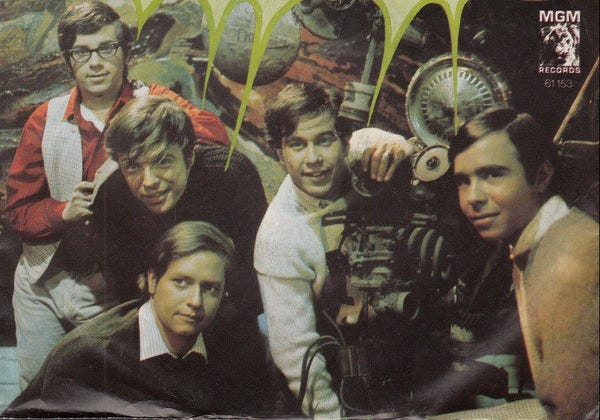
Whenever a group from yesteryear strikes my fancy, I’m always curious about its history and I’ll proceed to devour any bit of information I can find about it. In the case of Every Mother’s Son, I learned that they had formed in New York City in 1966 and that the heart of this talented band comprised two brothers, Lary and Dennis Larden. At the time, Lary was twenty-one while Dennis was eighteen. The siblings, who both sang and played guitar, had had a folk act for a few years. They decided to go electric in order to get gigs at university fraternity houses. It was at frat parties that Lary and Dennis met the fellows who would complete the lineup of their new group, Every Mother’s Son. Joining the Lardens were keyboardist/vocalist Bruce Milner, bassist Schuyler Larsen, and drummer Christopher Augustine.
The quintet had an appealing boys next door image and it quickly found a manager, Peter Leeds, who shared an office with ace producer/tunesmith Wes Farrell. If his name rings a bell, it’s because Farrell was responsible for co-writing songs you might know such as “Boys” by the Shirelles (covered by the Beatles on their debut album), “Come a Little Bit Closer” by Jay and the Americans, and, believe it or not, over two dozen tracks by the Partridge Family!
A ditty that Farrell had cooked up with Strangeloves member Jerry Goldstein made its way to Every Mother’s Son. “Come and Take a Ride in My Boat” was the original name of the tune and the New York garage outfit, the Rare Breed, came out with it in September 1966. The song wasn’t a hit but, with a somewhat different title and Farrell producing, Every Mother’s Son’s stab at it on the MGM label clicked bigtime. The band was on its way.
Not only did Lary, Dennis, and the lads show up on TV music shows to promote their smash, they also appeared in a nightclub scene on the popular spy series, The Man from U.N.C.L.E. Television viewers were treated to the amusing sight and sound of Every Mother’s Son playing “Come On Down to My Boat” while a fight broke out on the dancefloor.
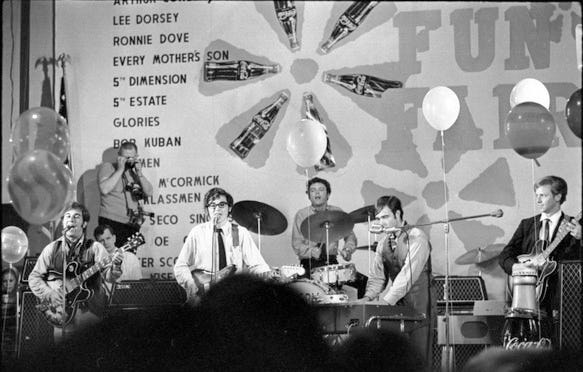
Among their live appearances, two highly notable ones took place at the Fantasy Fair and Magic Mountain Music Festival happening near San Francisco in early June 1967. This two-day extravaganza was scheduled just a few days prior to the famous Monterey Pop Festival and is pretty much forgotten nowadays. But it boasted a fantastic assortment of acts including the Doors, the Merry-Go-Round, the Byrds, and Jefferson Airplane. Every Mother’s Son was one of two groups having the opportunity to perform on both days, sharing the stage with the above-mentioned bands and many more.
In April ‘67, along with the tune that nabbed them a Top Ten hit, Every Mother’s Son’s self-titled LP was released. With the exception of “Come On Down to My Boat”, the ten other tracks on it were composed by the Larsen brothers and shared a soft rock approach similar to that of other East Coast harmony poppers, the Critters and the Cyrkle. (Check out my early July post on the latter elsewhere on this Substack.) In addition to their hit and a few pretty ballads are three top-notch lightly rocking numbers which complement “Allison Dozer”, the platter’s most aggressive offering.
Every Mother’s Son managed to reach #117 on the charts and despite it not being a big seller, MGM Records nevertheless allowed the group to release a couple more singles in 1967. “Put Your Mind at Ease”/“The Proper Four Leaf Clover” was shipped to record stores in August. The disc climbed to a respectable forty-sixth position in the States but actually got as far as #8 in my native Canada, no doubt reflecting the good taste of my countrymen! All kidding aside, both songs are expertly crafted melodic marvels and might very well represent Every Mother’s Son at their peak. Dig them as they lip-synch to the A-side while wearing fashionably colorful threads on the TV variety show Hollywood Palace.
The third Every Mother’s Son single of 1967 came out in October: “Pony With the Golden Mane”/“Dolls in the Clock”. Barely getting into the Top 100, it’s still a decent couple of tunes, though I admit that the A-side in particular is a little too twee for my admittedly sugary tastes. Better are some of the other tracks on the group’s second and final long-player, Every Mother’s Son’s Back, from late ‘67. It’s almost entirely made up of songs penned by Lary and Dennis Larson with occasional collaborations on the part of Bruce Milner and Schuyler Larsen. The album’s highlights other than “The Proper Four Leaf Clover” and “Put Your Mind at Ease” include the sprightly “Rainflowers”, the lovely Byrds-influenced “Another Day Another Song”, and the cool fast-paced garage pop number, “I’d Rather Be Right than Wrong”.
Alas, the sales of Every Mother’s Son’s Back were subpar even compared to those of the combo’s first album. By this time, bass player Schuyler Larsen had left the group and was replaced by Don Kerr. It was this slightly revamped lineup that cut the group’s gorgeous creative swansong “No One Knows”. Released on a 7-inch in January 1968, it actually fared worse commercially than “Pony With the Golden Mane” but that was certainly no reflection on the high quality of the tune.
One last single containing material from their two albums went unnoticed in September ‘68, and with record buyers not exactly clambering for their vinyl, it wasn’t long before Every Mother’s Son called it quits. Of their members, it was Dennis Larden who was the most creatively active after the group’s breakup, playing in country singer Rick Nelson’s Stone Canyon Band and portraying a rock musician in the 1970 film comedy, The Phynx.
For a long time, Every Mother’s Son weren’t especially well served in the reissue market. Thankfully, the excellent Now Sounds reissue label released a first-rate collection of all their recordings in 2012. The group emerged right at the time when the divide between rock and pop was increasingly pronounced. The newly-formed underground FM radio stations blasted out harder psychedelic sounds while AM Top Forty stations gave ample airplay to lighter harmony-fueled hits by artists like the Turtles, the Association, and Every Mother’s Son. Snobby rock critics snidely categorized such combos as being unworthy of serious consideration and admiration, but, today, passionate listeners and collectors give them the love they truly deserve. And that, to paraphrase the title of my fave Every Mother’s Son song, never fails to put my mind at ease!